
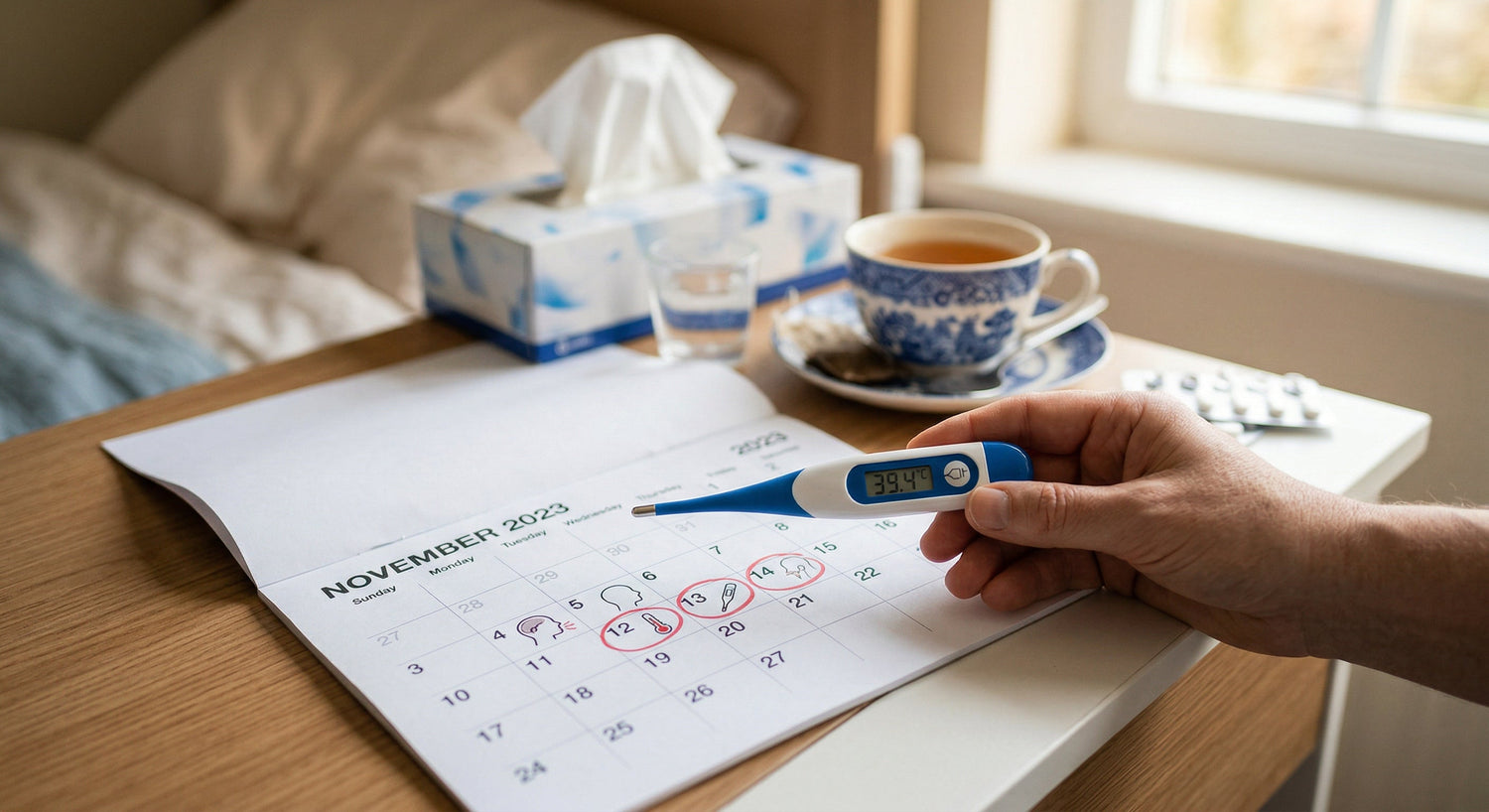
Cough, fever, sore throat - but is it COVID-19, influenza, or RSV? During respiratory virus season, symptoms of these three infections overlap so much that even doctors cannot distinguish them without testing. A combo rapid test solves this problem in about 15 minutes with a single nasal swab, detecting multiple pathogens at once. In the 2025/2026 season, the Robert Koch Institute (RKI) recorded overlapping waves of influenza A(H3N2), RSV, and seasonal coronaviruses in Germany, making combo testing more relevant than ever. This buying guide compares every combo test available in Germany, explains the differences between 3-in-1, 4-in-1, and 5-in-1 kits, and helps you choose the right one for your situation.
Why a Combo Test? Advantages Over Single Tests
The core benefit of a combo rapid test is simple: one swab, one test cassette, multiple results. Instead of buying and performing separate tests for COVID-19, influenza, and RSV, a combo test checks for all of them simultaneously. This matters for several practical reasons.
Cost savings. A single combo test typically costs between 1.39 EUR and 2.99 EUR, depending on the manufacturer and how many pathogens it detects. Buying three separate single tests for the same pathogens would cost significantly more - a COVID antigen test alone starts at around 0.49 EUR, and a dedicated influenza test adds another 1 to 3 EUR, plus an RSV test on top of that.
Convenience and comfort. One nasal swab is enough. Anyone who has performed a nasal swab knows it is not the most pleasant experience, especially for children. With a combo test, you only need to do it once rather than three times.
Faster clinical decisions. Knowing whether you have influenza rather than COVID-19 or RSV can change treatment decisions. Influenza can be treated with antivirals like oseltamivir (Tamiflu) if started within 48 hours. COVID-19 may warrant Paxlovid for high-risk patients. RSV in young children or the elderly may require closer medical monitoring. A combo test gives you an immediate indication of which virus is causing symptoms.
Reduced virus spread. When you know which virus you have, you can inform close contacts more precisely, and they can take targeted precautions. This is especially important in households with young children, elderly relatives, or immunocompromised individuals.
3-in-1 vs. 4-in-1 vs. 5-in-1: Which Combo Test is Right for You?
Combo tests differ primarily in how many pathogens they detect. Here is what each type covers:
3-in-1 tests detect SARS-CoV-2 (COVID-19), Influenza A, and Influenza B. These are the most affordable option and a good choice if your main concern is distinguishing COVID from the flu. They do not test for RSV. A typical example is the Safecare 3in1 Corona & Influenza Test at 1.39 EUR per test.
4-in-1 tests detect SARS-CoV-2, Influenza A, Influenza B, and RSV. This is the most popular category for families and the best balance of coverage and price. The RSV component is particularly important for households with young children (under 2 years) or elderly family members, as RSV can cause severe lower respiratory tract infections in these groups. The CorDx 4in1 Combo Test and the Fluorecare 4in1 Combo Test are among the most widely used 4-in-1 tests in Germany.
5-in-1 tests detect all of the above plus adenovirus (ADV). Adenoviruses cause conjunctivitis, gastroenteritis, and respiratory infections, and are particularly common in children attending daycare or school. The Medomics 5in1 Self-Test and the Deepblue 5in1 Combo Test offer this extended panel.
Our recommendation: For most households, a 4-in-1 test provides the best value. It covers the three most clinically relevant respiratory viruses of the winter season (COVID, flu, RSV) at a price only marginally higher than a 3-in-1 test. Choose a 5-in-1 if you have young children who are frequently exposed to adenovirus in group settings.
Comparison Table: All Combo Tests at a Glance
The following table compares all combo rapid tests currently available at parahealth. All tests are CE-marked and approved for home use (self-tests) unless noted otherwise.
| Test | Type | Pathogens | Price per Test | Sensitivity (SARS-CoV-2) | Sample |
|---|---|---|---|---|---|
| Safecare 3in1 | 3-in-1 | COVID, Flu A/B | 1.39 EUR | 86.4% | Nasal swab |
| Fluorecare 4in1 | 4-in-1 | COVID, Flu A/B, RSV | from 1.69 EUR | 92.9% | Nasal swab |
| CorDx 4in1 | 4-in-1 | COVID, Flu A/B, RSV | 1.99 EUR | >90% | Nasal swab |
| Safecare 4in1 (25er) | 4-in-1 | COVID, Flu A/B, RSV | 1.20 EUR (29.99 EUR / 25 pcs) | >90% | Nasal swab |
| Medomics 5in1 | 5-in-1 | COVID, Flu A/B, RSV, ADV | 2.99 EUR | >92% | Nasal swab |
| Deepblue 5in1 | 5-in-1 | COVID, Flu A/B, RSV, ADV | 1.99 EUR | 95.0% | Nasal swab |
All prices reflect current single-test pricing. Bulk packs (20 or 25 tests) are available for most models and offer a lower per-test price. Browse the complete selection in our combo test collection.
How to Use a Combo Rapid Test: Step-by-Step
All combo rapid tests follow the same basic procedure, regardless of manufacturer. The process takes about 15 to 20 minutes from swab to result. Here is how it works:
Step 1: Prepare. Wash your hands thoroughly. Open the test kit and lay out all components: the test cassette, the extraction tube with buffer solution, and the sterile swab. Read the manufacturer instructions carefully, as buffer volumes and waiting times may vary slightly between brands.
Step 2: Collect the sample. Insert the swab about 2 to 2.5 cm into one nostril (not deep into the nasopharynx - these are anterior nasal swab tests designed for home use). Rotate the swab gently against the nasal wall 5 times. Repeat in the other nostril with the same swab. Some tests (like the Deepblue Lolli test) use saliva instead of a nasal swab.
Step 3: Extract. Place the swab into the extraction tube containing the buffer solution. Rotate the swab at least 6 times, pressing it against the tube walls to release the sample material. Squeeze the tube gently while removing the swab to retain maximum liquid. Attach the dropper nozzle to the tube.
Step 4: Apply and wait. Apply the specified number of drops (usually 3 to 4) to the sample well on the test cassette. Start a timer. Most combo tests require 15 minutes for a complete result. Do not read the result before the minimum time (false negatives) or after the maximum time (false positives may appear).
Step 5: Read the result. A combo test cassette has multiple result windows or lines - one for each pathogen plus a control line (C). A visible line next to C confirms the test worked correctly. Lines next to the pathogen abbreviations (e.g., COV, FluA, FluB, RSV) indicate a positive detection. Even a faint line counts as positive.
For a detailed visual walkthrough, see our guide on how to correctly perform a home rapid test.
When Should You Test? A Symptom Decision Guide
The best time to test is when you have acute respiratory symptoms and need to know which virus is responsible. Here are the most common scenarios:
Fever plus cough or sore throat. This is the classic indication for a combo test. All three viruses - COVID-19, influenza, and RSV - can present with this symptom combination. A combo test helps differentiate within 15 minutes. According to the RKI, during the 2025/2026 winter season, influenza A(H3N2) was the dominant circulating strain, followed by RSV and seasonal coronaviruses.
Before visiting vulnerable individuals. If you plan to visit elderly relatives, newborns, or immunocompromised individuals and you have even mild cold symptoms, a combo test provides peace of mind. This is especially relevant during peak respiratory virus season (typically November through March in Germany).
Children with sudden high fever. In young children, RSV and influenza can cause rapidly worsening symptoms. A combo test helps parents decide whether to monitor at home or seek medical attention. If your child tests positive for RSV and is under 6 months old or has difficulty breathing, contact a pediatrician immediately.
Workplace and school decisions. Many employers and schools still recommend testing when symptomatic before returning to group settings. A combo test provides a comprehensive picture with a single test.
For a detailed symptom comparison between flu, RSV, and COVID, see our symptom comparison chart.
Where to Buy Combo Tests in Germany
Combo rapid tests are widely available in Germany through several channels:
Online shops (best selection and prices). Online retailers like parahealth.de offer the widest selection of combo tests, including 3-in-1, 4-in-1, and 5-in-1 models, often at significantly lower prices than brick-and-mortar stores. Bulk packs (20 to 25 tests) are readily available online and ideal for families, workplaces, or care facilities. Delivery typically takes 1 to 3 business days within Germany.
Pharmacies (Apotheken). German pharmacies carry combo tests, though the selection is usually limited to 1 to 2 brands. Prices tend to be 30 to 50% higher than online. The advantage is immediate availability and the option to ask a pharmacist for advice on test selection.
Drugstores (dm, Rossmann, Mueller). Large drugstore chains stock combo tests, typically the Fluorecare 4in1 or similar mass-market brands. Availability can be inconsistent, especially during peak infection waves when demand spikes. Prices are moderate - between pharmacy and online pricing.
Discount supermarkets (Aldi, Lidl). Occasionally offer combo tests as limited-time specials during respiratory virus season. Selection is very limited (usually one brand), and once sold out, restocking is unpredictable.
For professional or institutional needs (medical practices, care facilities, employers), professional-grade combo tests are available in our professional combo test collection.
Frequently Asked Questions
How accurate are combo rapid tests?
Combo rapid tests are antigen-based, meaning they detect viral proteins. Sensitivity for SARS-CoV-2 typically ranges from 86% to 95%, depending on the manufacturer. For influenza, sensitivity is generally above 90%, and for RSV above 92%. Specificity (the ability to correctly identify negative samples) is above 97% for all pathogens across most brands. For more on what these numbers mean, read our article on sensitivity vs. specificity in rapid tests.
Can a combo test detect multiple infections at the same time?
Yes. Co-infections (being infected with two viruses simultaneously) are possible, especially in children. A combo test will show positive lines for each detected pathogen. During the 2025/2026 season, the RKI documented cases of simultaneous influenza and RSV infections.
Do combo tests work with the latest COVID variants?
Yes. Antigen rapid tests detect the nucleocapsid (N) protein of SARS-CoV-2, which remains highly conserved across variants including the current Nimbus and Stratus subvariants circulating in 2026. For more on current variants, see our COVID-19 variants overview.
Are combo tests approved for children?
Most combo self-tests are approved for use in individuals aged 2 years and older, with the test performed by an adult. For children under 2, consult a pediatrician who can use a professional-grade test. Always check the specific age range in the manufacturer instructions.
What if only the control line appears?
If only the control line (C) is visible and no pathogen lines appear, the test result is negative for all tested pathogens. However, rapid tests can produce false negatives, especially in the very early stages of infection. If symptoms persist or worsen, test again after 24 to 48 hours or consult a doctor.
How should I store combo tests?
Store combo test kits at room temperature (2 to 30 degrees Celsius) in their sealed pouch until use. Do not refrigerate or freeze. Check the expiry date before testing - using expired tests reduces accuracy.
Can I use a combo test for travel?
Combo rapid tests are self-tests and generally not accepted as official proof of infection status for travel purposes. If you need a certified result, visit a test center or pharmacy that offers certified rapid testing. However, a self-test before travel is a responsible precaution.
Still have questions about which combo test is right for you? Browse our complete combo test selection or visit our influenza symptom guide and RSV symptom guide for more information.
