
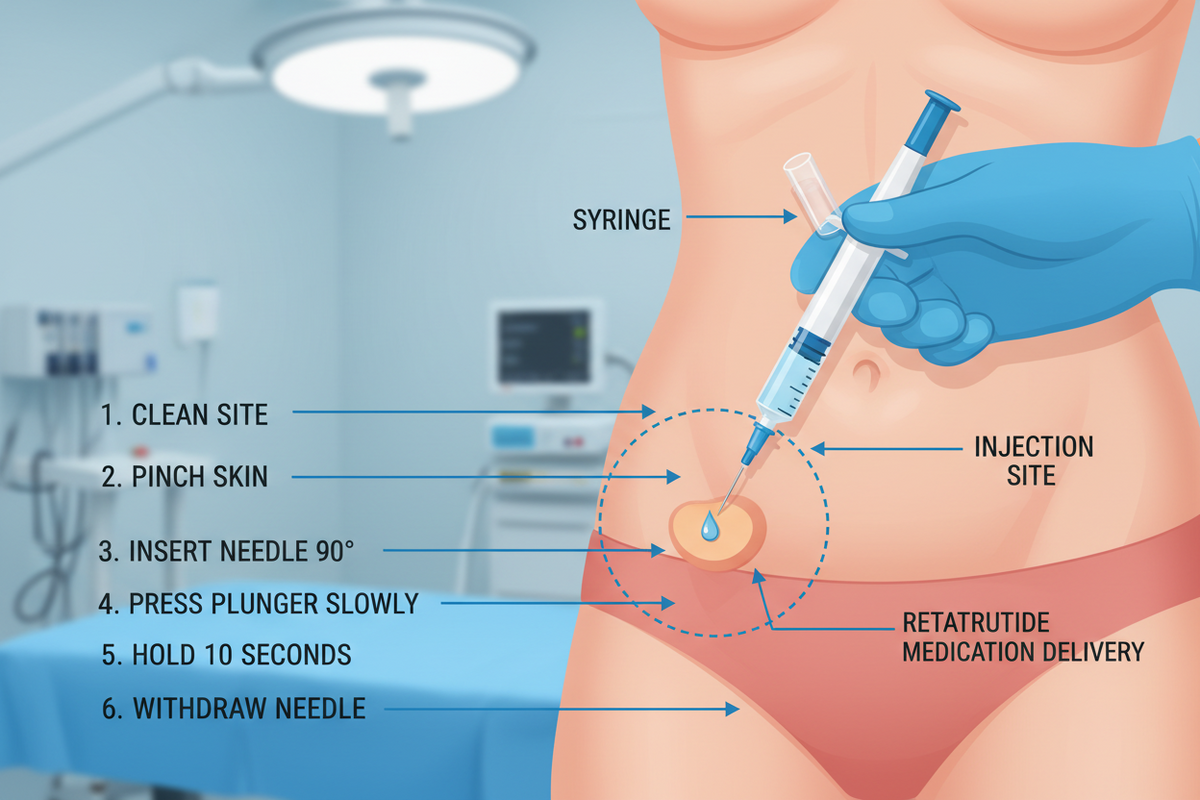
Key takeaways: how to inject retatrutide
- You take retatrutide as a subcutaneous injection (under the skin) once a week.
- Where to inject: the abdomen (at least 5 cm / 2 inches from the navel), the upper third of the thigh (front and side), the buttock, or the back of the upper arm (only if another person injects). No site gives better results; move to a new spot every time.
- Short version: choose a site, draw up the dose, lift a skin fold if needed, inject at 90 degrees, wait at least 5 seconds (ideally 10), dispose of the needle.
- The shortest needles are the first choice (6 mm on a syringe).
- One unit on a U-100 syringe equals 0.01 ml; mixing up U-40 and U-100 scales changes the volume 2.5-fold.
- Not approved anywhere as of September 2026; TRIUMPH-1 details and the filing plan are in the retatrutide regulatory timeline.
Introduction
Retatrutide is an investigational weekly injection. This guide shows how to inject retatrutide (often shortened to reta) step by step. A reta injection is a once-weekly subcutaneous injection; research material comes in a vial and is drawn up with a syringe. Below you will find the injection sites, needle and syringe, how many units to draw up, and timing.
What is retatrutide and how is it administered?
Retatrutide (LY3437943) is a single peptide developed by Eli Lilly that activates the GIP, GLP-1 and glucagon receptors. For a full overview of what retatrutide is and how the Phase 3 studies are set up, see the retatrutide Phase 3 program.
Research material is a lyophilized powder (research use only). You reconstitute it with bacteriostatic water before you draw up a dose; the reconstitution steps are covered later in this guide.
In the clinical studies, retatrutide is administered once weekly by subcutaneous injection. The half-life is approximately 6 days, and the pharmacokinetic profile supports once-weekly dosing. The sections that follow cover needle and syringe, injection sites, the step-by-step technique, and timing.
Choosing the right needle size for retatrutide
The needle is the part of the setup that decides how the injection feels and where the liquid ends up. The insulin injection guidelines (FITTER 2016 and the FIT UK recommendations, 2019) give a clear answer: the shortest needles are the first choice, because they are safe, effective and less painful, and they make an accidental intramuscular injection unlikely. On a pen that is a 4 mm needle, on a syringe a 6 mm needle. Retatrutide is not an approved medicine and comes with no manufacturer needle specification, so these guideline values are your reference point.
Match that reference point to the needles you can get. 8 mm and 12.7 mm syringe needles are common; use them only with a correctly lifted skin fold. Prefer a 6 mm syringe where you can get one. Below a BMI of 19, do not use syringe needles.
Needle gauge and length explained
Gauge (G) describes the outside diameter of the needle: the higher the number, the thinner the needle. A 30 G needle measures 0.30 mm in diameter. Thinner and shorter needles penetrate with less force and cause less pain, which is why the guidelines recommend the smallest suitable diameter rather than a fixed gauge.
Length matters more than gauge for safety. A 4 mm pen needle reaches the subcutaneous tissue when you inject at 90 degrees. A 6 mm syringe needle does the same and is the guideline first choice. An 8 mm needle usually still works, but only with a correctly lifted skin fold, and longer needles such as 12.7 mm raise the risk of an intramuscular injection and need the skin fold even more.
Pen needles follow the same logic: 4 mm is the first choice, and the fit depends on the pen you use. How to handle a pen needle on a pen is covered in the retatrutide pen section.
Why the shortest needle is the first choice
A 4 mm pen needle inserted at 90 degrees reaches the subcutaneous tissue with a low risk of intradermal or intramuscular injection (FIT UK), and intramuscular injections are to be avoided. Used at 90 degrees, short needles are exactly what the guidelines recommend.
With the 8 mm syringe needle, lift a skin fold between thumb and forefinger and inject into the fold at 90 degrees. Do not press the fold so hard that the skin blanches or hurts.
| Type | Length | Gauge | Note |
|---|---|---|---|
| Pen needle | 4 mm | 0.23 mm (32 G) | Guideline first choice; 4 mm at 90 degrees reaches subcutaneous tissue |
| Pen needle | 5, 6 and 8 mm | 31 G (0.25 mm) | FIT UK no longer recommends 6 and 8 mm pen needles; fit depends on the pen |
| Syringe needle | 6 mm | Guideline first choice for syringes | |
| Syringe needle | 8 mm | 30 G (0.30 mm) | Use only with a correctly lifted skin fold |
| Syringe needle | 12.7 mm | 0.33 mm | Skin fold required, higher risk of intramuscular injection |
U-100 vs. U-40 syringes: the critical difference
A common point of confusion when you prepare retatrutide is the difference between U-100 and U-40 syringes. The two labels look similar on the packaging, but they describe volume scales, not the strength of your peptide. On a syringe, U-100 means the scale is marked for 100 units per ml. Peptide solutions are not labeled that way: their strength is stated in milligrams per milliliter (mg/ml).
The markings on the barrel follow the scale. On a U-100 syringe, one unit marks 0.01 ml of liquid. On a U-40 syringe, one unit marks 0.025 ml. The numbers are volume markings. They do not tell you how many milligrams of active ingredient you draw up, and they are not units of the drug itself. Mixing up the two scales is a documented source of dosing errors and changes the delivered volume by a factor of 2.5.
What do U-100 and U-40 mean, and what happens if you mix them up?
U-100 and U-40 are both volume scales, not drug strengths. The fixed conversions are: 1 ml = 100 units on a U-100 syringe = 40 units on a U-40 syringe. One unit marks 0.01 ml on U-100 and 0.025 ml on U-40. U-100 is the standard insulin strength in the United States. U-40 is not used for human insulin there and is common in veterinary use, where U-40 insulin is given only with U-40 syringes.
You can tell the two scales apart only by the imprint on the syringe. U-40 syringes often have a red cap and a red scale, while U-100 syringes usually have an orange needle cover and a black scale. That color coding is only an orientation. The printed U-40 or U-100 marking is what counts.
If you mix up scale and solution, the error follows a factor of 2.5. A unit number calculated for a U-100 syringe, drawn up on a U-40 syringe, delivers 2.5 times the intended volume. The reverse mistake delivers 0.4 times the intended volume.
| Scale | Units per ml | Volume per unit | Risk if you mix up the scales |
|---|---|---|---|
| U-100 | 100 units per ml | 0.01 ml per unit | A U-100 number on a U-40 syringe delivers 2.5 times the intended volume |
| U-40 | 40 units per ml | 0.025 ml per unit | A U-40 number on a U-100 syringe delivers 0.4 times the intended volume |
Why the syringe scale must match your calculation
Peptide products do not come at a U-100 or U-40 strength. Their strength is stated in mg/ml: the approved peptide product EGRIFTA WR, for example, is 8 mg/ml after reconstitution. Your calculation starts from that concentration, and the syringe scale must match it: units = ml x 100 on a U-100 syringe, or ml x 40 on a U-40 syringe.
The formula is: volume (ml) = dose (mg) / concentration (mg/ml), then units = ml x 100 on a U-100 syringe. If scale and calculation do not match, the error is 2.5-fold. A vial example follows in the next section. For the full conversion, see the retatrutide dosage chart in units. When you order syringes and needles, the scale on the syringe must match your calculation (U-100 or U-40).
Drawing up your dose: mg, ml, and units on the syringe
Retatrutide vials are labeled in mg, while a U-100 syringe is read in units. Three conversions connect the two: concentration (mg/ml) = vial content (mg) / solvent (ml); volume (ml) = dose (mg) / concentration (mg/ml); units on a U-100 syringe = volume (ml) x 100, because one unit on a U-100 syringe equals 0.01 ml.
Worked example: a 10 mg vial plus 2 ml of bacteriostatic water gives a concentration of 5 mg/ml. A 2 mg dose then equals 0.4 ml, or 40 units on a U-100 syringe. A 20 mg vial plus 4 ml gives the same 5 mg/ml. The same pattern works for other vials: 30 mg plus 3 ml gives 10 mg/ml.
For other vial sizes and doses, start with the retatrutide dosage guide and its retatrutide dosage chart in units, or run the numbers in the retatrutide calculator.
Reconstituting retatrutide (before you draw up a dose)
Retatrutide comes as a lyophilized powder in a sealed vial, and you dissolve it before you draw up a dose. How much BAC water to add to a 5, 10, 20 or 30 mg vial is listed in the retatrutide reconstitution guide.
- Put the material within reach: the vial, bacteriostatic water (BAC water), a sterile syringe and needle for the water, a new U-100 syringe for the dose, and alcohol swabs.
- Check the powder: it should be a dry cake or loose powder without discoloration.
- Wipe the rubber stoppers of the peptide vial and the water vial with an alcohol swab and let them air-dry.
- Draw up the amount of water you plan to use with the syringe for the water, for example 2 ml for a 10 mg vial (that gives 5 mg/ml).
- Let the water run slowly down the wall of the vial.
- Swirl the vial in a gentle circular motion until the powder has dissolved. Do not shake the vial.
- Check the solution: it should be clear and free of particles. Do not use it if you see particles, cloudiness or discoloration.
- Label the vial with the date and store it cool. Storage per BergdorfBio: 2 to 8 °C, light-protected, and 28 days at 2 to 8 °C after reconstitution. There are no published manufacturer or peer-reviewed stability data for reconstituted retatrutide.
On a U-40 syringe the same unit number would deliver 2.5 times the volume.
How bacteriostatic water works and how long an opened vial keeps is covered in our bacteriostatic water guide.
How many units to draw up per dose (U-100 syringe)
The table below lists the phase 3 study doses and two figures from the BergdorfBio retatrutide product page, labeled as reported use, each converted to volume and units on a U-100 syringe at 5 mg/ml and at 10 mg/ml. All volumes and unit figures are calculated from the formulas above, not dosing recommendations.
| Stage | Dose (mg per week) | Concentration | Volume (ml) | Units on a U-100 syringe | Note |
|---|---|---|---|---|---|
| Study dose | 2 mg | 5 mg/ml (10 mg vial + 2 ml) | 0.4 ml | 40 units | calculated |
| Study dose | 4 mg | 5 mg/ml (10 mg vial + 2 ml) | 0.8 ml | 80 units | calculated |
| Study dose | 6 mg | 10 mg/ml (30 mg vial + 3 ml) | 0.6 ml | 60 units | calculated |
| Study dose | 9 mg | 10 mg/ml (30 mg vial + 3 ml) | 0.9 ml | 90 units | calculated |
| Study dose | 12 mg | 10 mg/ml (30 mg vial + 3 ml) | 1.2 ml | 120 units | calculated; 1.2 ml, more than a 1-ml syringe holds |
| reported use (provider) | 0.5 mg | 5 mg/ml | 0.1 ml | 10 units | BergdorfBio beginner protocol; study start is 2 mg |
| reported use (provider) | 2 to 12 mg | depends on the vial | see calculator | see calculator | BergdorfBio advanced protocol; matches the study range |
The study doses and when they are increased are explained in the retatrutide titration schedule.
Best injection sites for retatrutide

The best injection sites for retatrutide are the abdomen, the thigh, the upper arm, and the buttock. All four are subcutaneous (under the skin). The instructions for use of an approved incretin pen (Zepbound KwikPen) list the abdomen, the thigh, and the upper arm as approved injection areas, and the FIT UK recommendations, 2019 add the buttock. Whichever area you choose, use healthy skin and move to a new spot for every injection. Some areas are off limits (see below).
On the abdomen, keep your distance from the navel. The Zepbound KwikPen instructions for use call for at least 2 inches (about 5 cm). The FIT UK recommendations give 2 cm as a lower bound. Use at least 5 cm (2 inches) as the main rule, and never inject directly into or around the navel.
There is no data that one site produces better results than another; the Zepbound KwikPen instructions for use list abdomen, thigh and upper arm as equivalent options. Short and thin needles reduce pain at any site. Your own comfort and routine decide which of the four you pick.
Use the table for a quick overview of where to inject and what to avoid. The subsections below cover each site in detail.
| Site | Where exactly | What to avoid | Note |
|---|---|---|---|
| Abdomen | At least 5 cm (2 inches) from the navel | The navel area | Main recommendation: 5 cm (2 inches); FIT UK gives 2 cm as a lower bound |
| Thigh | Upper third, front and side | Scars, bruises, lipohypertrophy | Use a skin fold with syringe needles longer than 4 mm |
| Upper arm | Back of the upper arm | Scars, bruises, lipohypertrophy | Only with another person |
| Buttock (glute) | Fatty tissue of the buttock, listed as an injection area by FIT UK | Scars, bruises, lipohypertrophy | Move the spot with every dose |
| Sites to avoid | Do not inject here | Scars, bruises, injuries, lipohypertrophy, inflamed skin | Includes the navel and hardened tissue |
How to inject retatrutide in the stomach
The abdomen is the site most people use first. Inject subcutaneously, into the fatty tissue under the skin of the belly. Stay at least 5 cm (2 inches) away from the navel, as the Zepbound KwikPen instructions for use state. The FIT UK recommendations give 2 cm as an absolute lower bound; treating 5 cm (2 inches) as your minimum is the safer habit. Keep out of the ring directly around the navel.
The abdomen is easy to reach and easy to see, so you can place the needle where you plan to. With syringe needles, lift a skin fold before you inject; the exact technique is in the step-by-step guide.
Do not inject into scars, bruises, injuries, or lipohypertrophy (the lumpy, hardened tissue that repeated injections can cause). Move the exact spot with every dose, and rotate between areas over time.
How to inject retatrutide in the thigh
Use the upper third of the thigh, on the front and the side (FIT UK recommendations).
With syringe needles longer than 4 mm, lift a skin fold (see the step-by-step guide). If your BMI is under 19, the FIT UK recommendations do not advise syringe needles; ask a healthcare professional what to use instead.
The thigh gives you room to move the exact spot with each dose, and you can reach it yourself.
The upper arm (only with another person)
The back of the upper arm is a valid site, but you cannot inject it yourself. Both the FIT UK recommendations and the Zepbound KwikPen instructions for use state that another person gives this injection. So skip this site when you are injecting alone, and do not twist around to reach the back of your arm. Use the abdomen, the thigh, or the buttock instead.
Can you inject retatrutide in the glute?
Yes. The FIT UK recommendations list the buttock as a subcutaneous injection site alongside abdomen, thigh and upper arm. Lift a skin fold with syringe needles and include the site in your rotation.
Areas to avoid
Avoid injecting into:
- Scar tissue
- Bruising or injuries
- Infected or inflamed skin
- Lipohypertrophy areas (lumpy or hardened tissue from repeated injections)
- The navel and the area directly around it
Do not inject into scars or into hardened tissue. Repeated injections into lipohypertrophy can make absorption unreliable. If you find such an area, leave it out and choose another site.
Step-by-step guide: how to inject retatrutide correctly
The sequence below is the same one used for subcutaneous self-injection in general, following the insulin injection guidelines (FITTER 2016 and the FIT UK recommendations, 2019). In community language this is often called "pinning". Work through the steps in order until the routine is familiar.
Step 1: Preparation and hand washing
Wash your hands with soap and warm water and dry them. Clean technique is the part that prevents infection, so do it before you touch any of the materials.
Step 2: Gather your materials
Lay out everything before you start: your retatrutide vial, a new syringe with the correct scale (see the injection supplies and syringes and needles collections, and check that the scale is U-100 or U-40 to match your calculation), alcohol wipes or sterile gauze, and a clean flat surface.
Step 3: Inspect the vial
Check the powder before reconstitution: it should be a dry cake or loose powder without discoloration. After you have dissolved it (see the reconstitution section), hold the vial up to the light and check the solution for clarity, particles, cloudiness or discoloration. If anything looks wrong, do not use the vial.
Step 4: Prepare the injection site
The skin should be clean and dry. Disinfection is not mandatory; if you use an alcohol wipe, let the skin air-dry completely before you inject, because wet alcohol stings. There is no fixed number of seconds for this.
Step 5: Draw up the injection
Draw air into the syringe equal to the dose volume (or slightly more) and push that air into the vial; this makes withdrawal easier and is the technique the injection guidelines describe. Then turn the vial and draw your dose, keeping the needle tip below the liquid surface. If you are unsure how much to draw up, use the retatrutide calculator or the conversion table above.
Step 6: Remove air bubbles
Hold the syringe needle-up, tap the barrel gently and push the air back into the vial until only the dose remains. Small bubbles are harmless, but large ones make the volume inaccurate.
Step 7: Pinch the skin
Lift a skin fold between thumb and forefinger. Do not press so hard that the skin blanches or hurts. With a 4 mm pen needle you can inject without a fold; with syringe needles longer than 4 mm the fold is required.
Step 8: Insert the needle
Insert the needle in one smooth motion at 90 degrees to the surface of the skin fold. A 45 degree angle is not recommended in the injection guidelines.
Step 9: Inject the solution
Push the plunger slowly and steadily until the syringe is empty. Injecting too fast can hurt and bruise, so take your time; the guidelines do not set a fixed number of seconds.
Step 10: Remove the needle
Keep the needle in the skin for at least 5 seconds after the plunger is down, ideally for a count of 10. Then withdraw at the same angle and release the skin fold.
Step 11: Aftercare of the injection site
Press the site gently with gauze if there is a drop of blood. Do not rub the area. Small bruises happen; in the insulin guidance they do not affect absorption. The sources recommend neither ice nor heat. Then dispose of the needle as described in the disposal section.
How often to inject retatrutide
In the clinical studies retatrutide is injected once per week, subcutaneously. That schedule follows the pharmacokinetics: the half-life is about 6 days, which supports a once-weekly dose. Pick one day of the week and keep it; the interval is what matters, not the clock. The retatrutide half-life and interval section covers the numbers in detail.
Choosing your injection day
Choose a fixed weekday you can keep, and inject on that day each week. A consistent day makes the schedule easy to remember and keeps the interval steady.
Best time to take retatrutide: morning or night?
There is no documented time of day. Morning and night have not been compared in the studies, and with a half-life of about 6 days the weekday matters far more than the clock. If you ask whether you can take retatrutide at night: yes, morning or night both work, as long as you keep the same day each week. Can you take retatrutide on an empty stomach? No study has tested timing around meals, so there is no rule either way; the fixed weekday is what counts.
What if you miss a dose?
There is no approved product information for retatrutide, so there is no official rule for a missed dose. Do not double a dose to make up for a missed injection; ask a doctor how to continue.
Reta syringe or pen? Weight-loss injection with a syringe
Most people searching for this guide are looking for one of two things: how a weight-loss injection with a syringe works, or whether a retatrutide pen exists. For vial material the syringe is the only practical route. In the clinical studies retatrutide is injected subcutaneously once a week; which injection device the trials use is not published, and Lilly has compared two injection devices in a phase 1 study (NCT06003465). Research material comes as a lyophilized powder in a vial, and a vial is handled with a syringe.
There is no approved retatrutide pen in any country. Products sold as a retatrutide pen are third-party goods, often labeled "research use only". For vial material the syringe or pen question therefore has one practical answer: the syringe, with the scale matched to your calculation.
Retatrutide pens you see online
Listings for multi-dose pens appear under many brand names, each with its own mg strength on the label. None of them is an approved medicine or an approved device, and the labels are provider claims without an approval reference. If you handle such a product at all, the only reliable arithmetic is the label itself: on a multi-dose pen, the content and the total volume printed on the label give the concentration (mg per ml), and mg per click is that concentration times the volume the pen delivers per click. Work out the concentration and the volume per dose with the retatrutide calculator rather than trusting a dial setting.
How to use a retatrutide pen: pen needles and clicks
Pen needles follow the same logic as syringe needles: 4 mm is the first choice. A 4 mm pen needle measures 0.23 mm (32 G), and pen needles in 31 G (0.25 mm) come in 5, 6 and 8 mm lengths; FIT UK no longer recommends 6 and 8 mm pen needles. The fit depends on the pen you use. Screw on a new pen needle for every injection. Work out the concentration from the content and the total volume on the label (use the retatrutide calculator); mg per click is that concentration times the volume per click. With a 4 mm pen needle inject at 90 degrees without a skin fold, leave the needle in the skin for at least 5 seconds (ideally 10), then take the needle off and dispose of it.
Insulin syringes: the common alternative
An insulin syringe with a thin needle is the practical route for vial-based dosing. Check that the scale matches your calculation (U-100 or U-40), use a new syringe and needle for each injection, and pick the shortest needle that suits you. The syringes and needles collection covers the range. For research handling, retatrutide comes as a vial that you draw up with an insulin syringe; the same syringe arithmetic (mg, ml, units) applies to other research peptides such as BPC-157 or TB-500, while storage and stability are product-specific.
Rotating injection sites: why and how
Repeated injections into the same spot can cause lipohypertrophy, firm thickened tissue that absorbs the dose unpredictably. Rotation prevents that and keeps absorption steady. Two rules cover it: keep each new injection at least 1 cm away from the previous one, and do not use the same spot more often than about every four weeks.
A simple eight-week rotation looks like this:
- Week 1: abdomen, right of the navel
- Week 2: abdomen, left of the navel
- Week 3: right thigh, outer upper third
- Week 4: left thigh, outer upper third
- Week 5: abdomen, right, slightly higher
- Week 6: abdomen, left, slightly higher
- Week 7: right thigh, different spot
- Week 8: left thigh, different spot
Repeat the cycle afterwards and keep a small distance between any two injections.
The same subcutaneous technique and site rotation apply to other peptides injected subcutaneously, for example MOTS-c and sermorelin.
Common injection mistakes to avoid
The ten errors below are the ones that show up most often:
- Using the wrong syringe scale. A U-100 number on a U-40 syringe delivers 2.5 times the intended volume.
- Injecting too fast. Go slow and steady; there is no documented number of seconds.
- Reusing needles. A new needle for every injection keeps the tip sharp and the site clean.
- Injecting straight from the fridge. Cold solution often stings more; let the vial come to room temperature for about 15 minutes first (the value comes from insulin guidance).
- Drawing up the wrong volume. Read the scale twice, especially for small volumes, and call them units on the syringe, not IU.
- Injecting into scars, bruises or lipohypertrophy. If the tissue feels unusual, choose another site.
- Skipping rotation. Same spot plus time equals lipohypertrophy.
- Forgetting the skin fold with longer syringe needles.
- Ignoring storage. Storage per BergdorfBio: 2 to 8 °C and 28 days after reconstitution.
- Rushing. A calm setup prevents most of the errors above.
Safe needle disposal
Used needles and syringes are single-use items; a new one for each injection prevents infections and blocked needles.
- Put the needle and syringe into a puncture-resistant sharps container right after the injection.
- If you have no sharps container, use a sturdy plastic household container with a puncture-resistant lid.
- Never put loose needles in household trash or recycling.
- Dispose of the full container according to local rules (in the U.S., follow your community guidelines per the FDA two-step rule; in Germany, used syringes with the needle cap on may go into residual household waste).
Returning the container to a pharmacy or clinic is an option, not a general obligation.
Retatrutide status in September 2026
As of September 2026, retatrutide is an investigational compound. It is not approved by any regulatory authority worldwide. Lilly plans to file a Biologics License Application with the FDA in the first quarter of 2027; expanded access for single patients has existed since June 2026. Of the Phase 3 program, only TRANSCEND-T2D-1 has been peer-reviewed and published so far.
TRIUMPH-1 reported -28.3% (efficacy estimand) and -25.0% (treatment-regimen estimand) body weight after 80 weeks on 12 mg (press release, not yet peer-reviewed). See the retatrutide regulatory timeline.
Frequently asked questions
Where do you inject reta?
Into the subcutaneous tissue of the abdomen, the front and side of the upper thigh, the back of the upper arm (only if another person injects) or the buttock (glute). Keep at least 5 cm (2 inches) away from the navel, move to a new spot with every dose and rotate between the areas over time.
What needle size for retatrutide?
The guideline first choice is the shortest needle: 4 mm on a pen, 6 mm on a syringe. 8 mm and 12.7 mm syringe needles are common; use the 8 mm syringe needle only with a correctly lifted skin fold, and the 12.7 mm length raises the risk of an intramuscular injection. FIT UK no longer recommends 6 and 8 mm pen needles.
Can you inject retatrutide in the thigh?
Yes. Use the upper third of the thigh, front and side, and lift a skin fold if your syringe needle is longer than 4 mm. Rotate to the other thigh on your next injection and move the exact spot with every dose so the tissue stays healthy.
What time of day should I inject retatrutide, morning or night?
Either works. No study has compared morning and night, and with a half-life of about 6 days the weekday matters more than the clock. Keep the same day each week and pick the time you will remember. No study has tested timing around meals either, so there is no rule for food; the fixed weekday is what counts.
Where to inject retatrutide for best results?
There is no data that one site produces better results than another. The Zepbound KwikPen instructions for use list abdomen, thigh and upper arm as equivalent options, and the FIT UK recommendations add the buttock. Choose the site you can reach and rotate it, and keep at least 5 cm (2 inches) from the navel on the abdomen.
What if I miss a retatrutide dose?
There is no official rule, because retatrutide has no approved product information. Do not double a dose, and ask a doctor how to continue. With a half-life of about 6 days, the weekly interval matters more than the exact hour; the retatrutide half-life and interval section covers the numbers.
How do you take retatrutide?
You take retatrutide as a once-weekly subcutaneous injection: choose a site, draw up the dose, lift a skin fold if needed, insert at 90 degrees, inject slowly, wait at least 5 seconds (ideally 10), withdraw and dispose of the needle. The step-by-step guide walks through every move.
Is there a retatrutide pen?
No approved retatrutide pen exists in any country. Lilly has tested two injection devices in a phase 1 study, but none is approved. What is sold as a pen is third-party research-use-only hardware. Vial-based research material is drawn up with an insulin syringe; see the syringe-or-pen section.
What syringe should you use for retatrutide?
One whose scale matches your calculation: U-100 for the common math (1 unit = 0.01 ml) or U-40 (1 unit = 0.025 ml). Peptide strength is stated in mg/ml, not in insulin units, and mixing up the two scales changes the delivered volume by a factor of 2.5. Use a new syringe and needle for each injection.
How many units of reta should I take?
Units are volume, not milligrams, so the answer depends on your concentration. Formula: volume (ml) = dose (mg) / concentration (mg/ml), then units = ml x 100. At 5 mg/ml a 2 mg dose is 40 units. The full chart is in our retatrutide dosage guide.
What are the most common side effects of retatrutide injections?
Gastrointestinal events are the most common in the studies: nausea was the leading event (for example 28.6 to 42.4 percent across the TRIUMPH-1 dose groups versus 14.8 percent on placebo; TRIUMPH-1 press release, not yet peer-reviewed). The full breakdown sits in the retatrutide side effects section.
Can you drink alcohol while taking retatrutide?
There are no study data on drinking alcohol while taking retatrutide, so nothing is known about combining the two. Ask your doctor about alcohol use; the retatrutide side effects section covers what the studies report.
Conclusion
Retatrutide is injected once a week, subcutaneously; vial material is drawn up with a syringe whose scale matches your calculation. Choose the abdomen, the thigh or the buttock, or the back of the upper arm if another person injects, and keep at least 5 cm (2 inches) from the navel. Use the shortest needle you can, lift a skin fold with longer syringe needles, inject at 90 degrees, wait at least 5 seconds (ideally 10) and dispose of the needle safely. Rotate your sites, keep the same weekday, and treat every dose figure as study data or a provider statement.
Medical disclaimer
This article is for information only and is not medical advice. Retatrutide is an investigational compound that is not approved in any country; access is limited to participants in Lilly studies, and since June 2026 through expanded access for qualifying patients. It has not been studied in pregnancy or breastfeeding; as an unapproved investigational compound it does not belong in either situation outside a clinical trial. Talk to your doctor. parahealth assumes no liability for misuse or injury arising from this information.
Sources
- Urva S, Coskun T, Loh MT, et al. LY3437943, a novel triple GIP, GLP-1, and glucagon receptor agonist in people with type 2 diabetes: a phase 1b, multicentre, double-blind, placebo-controlled, randomised, multiple-ascending dose trial. Lancet 2022;400(10366):1869-1881. PMID 36354040
- Bajaj HS, Welch M, Shah P, et al. Efficacy and safety of retatrutide, a GIP, GLP-1, and glucagon receptor agonist, in people with type 2 diabetes and inadequate glycaemic control with diet and exercise (TRANSCEND-T2D-1): a double-blind, randomised, phase 3 trial. Lancet 2026;407(10546):2402-2413. PMID 42250575
- Eli Lilly. TRIUMPH-1 topline (May 21, 2026), NCT05929066. Press release
- Eli Lilly. Form 8-K, Q2 2026 financial results (August 5, 2026): BLA filing planned for Q1 2027. SEC EDGAR
- Eli Lilly. Pre-approval Expanded Access of Retatrutide, NCT07629401. ClinicalTrials.gov
- Eli Lilly. Similarity Between LY3437943 Versions for Different Injection Devices, NCT06003465. ClinicalTrials.gov
- Frid AH, Kreugel G, Grassi G, et al. New Insulin Delivery Recommendations (FITTER). Mayo Clin Proc 2016;91(9):1231-1255. PMID 27594187
- Forum for Injection Technique (FIT) UK. The UK Injection and Infusion Technique Recommendations, 5th Edition, 2019. PDF
- Eli Lilly. Instructions for Use, ZEPBOUND KwikPen (ZEPKP-0002-IFU-20260121). pi.lilly.com
- Eli Lilly. Instructions for Use, ZEPBOUND single-dose vial (ZEP-0002-VL-IFU-20260422). pi.lilly.com
- Barrera F, Murvelashvili N. Poorly Controlled Type 3c Diabetes due to Use of Veterinarian Insulin Syringes. Case Rep Endocrinol 2019;2019:7916435. PMID 31316841
- Theratechnologies. EGRIFTA WR (tesamorelin) Prescribing Information, 2025. DailyMed
- U.S. FDA. Best Way to Get Rid of Used Needles and Other Sharps, 2023. FDA
- Bavarian State Office for the Environment (LfU). Waste from medical facilities and home care (German), 2020. LfU Bavaria
- BergdorfBio. Retatrutide product page (research use only; vial sizes, reconstitution example, storage). bergdorfbio.com
